Свяжитесь с нами по электронной почте :
info@labcompanion.cn
-

-

Запрос звонка :
+86 18688888286

1. The Hidden Challenge: Combining Thermal Cycling with EMC Testing
In electronic product validation, thermal environmental testing and EMC compliance testing are traditionally performed separately. Manufacturers first complete temperature cycling reliability tests, then move the Device Under Test (DUT) to an anechoic chamber for emission and immunity verification.
However, critical device failures often only occur under combined thermal and electromagnetic stress — such as low temperature with specific RF fields or high temperature with transient interference. These intermittent issues cannot be replicated through separate tests, leading to undetected design flaws.
Many engineers attempt to run simultaneous thermal and EMC tests by placing the DUT inside a standard temperature chamber while connecting external antennas and measurement probes. In practice, this approach causes severe noise floor elevation of more than 10 dB, resulting in unreliable and invalid measurement data.
The root cause lies in the inherent electromagnetic leakage and self-noise defects of conventional thermal chambers.
2. Three Major EMC Leakage Weaknesses of Standard Temperature Chambers
Standard temperature chambers are designed purely for thermal insulation and moisture resistance, with no consideration for electromagnetic shielding. Their structural gaps, penetration openings, and internal electronics create unavoidable interference paths.
2.1 Door Seals & Viewing Windows: Uncontrolled RF Leakage Points
Standard door rubber gaskets are designed for thermal sealing only and provide zero attenuation for high-frequency electromagnetic waves. The hollow glass viewing windows contain no conductive shielding layer, acting as an open RF aperture on the chamber enclosure.
Within the 300MHz~3GHz common EMC frequency range, structural gaps match the wavelength scale, allowing external interference to couple into the chamber and internal DUT emissions to leak outward. This completely compromises test accuracy.
2.2 Tubing & Cable Penetrations: Natural Waveguide Paths
Refrigeration copper tubes, sensor wires, heater power cables, and fan motor wires must penetrate the chamber wall. Standard chambers only apply basic thermal sealing without RF shielding treatment.
These metallic pipelines and unfiltered penetrations act as waveguides, transmitting internal device noise outward and channeling external electromagnetic interference into the test volume.
2.3 Built-in Electrical Noise: The Chamber Itself Becomes an Interference Source
To achieve fast temperature ramping, standard chambers adopt SSR chopping heating, variable-frequency compressor drives, and DC fan speed regulation. These high-speed switching circuits generate significant broadband harmonics and RF noise.
The built-in noise radiates through air, chassis, and power lines. During EMC testing, receivers and probes capture chamber self-noise instead of the DUT’s true electromagnetic performance, making test results invalid.
3. Core Shielding Principles for EMC-Capable Thermal Chambers
A genuine EMC-rated temperature chamber is not simply a metal-shell chamber. It requires a systematic shielding design based on three non-negotiable principles: shielding continuity, full penetration filtering, and low-impedance grounding.
|
Principle |
Definition |
Implementation in Lab Companion Chambers |
|
Shielding Continuity |
No excessive gaps or apertures on the shielding enclosure to prevent RF leakage |
Finger-stock door shielding, metal mesh shielded window, waveguide cutoff tube structure |
|
Full Filtering |
All wires and signals crossing the shield boundary must be filtered |
EMI power filters, filtered signal connectors, isolated fiber penetration |
|
Low-Impedance Grounding |
Stable low-resistance return path for stray current and static discharge |
Independent inner chamber grounding, multi-point earth bonding, dedicated grounding bus |
4. Lab Companion Engineered EMC Shielding Solutions
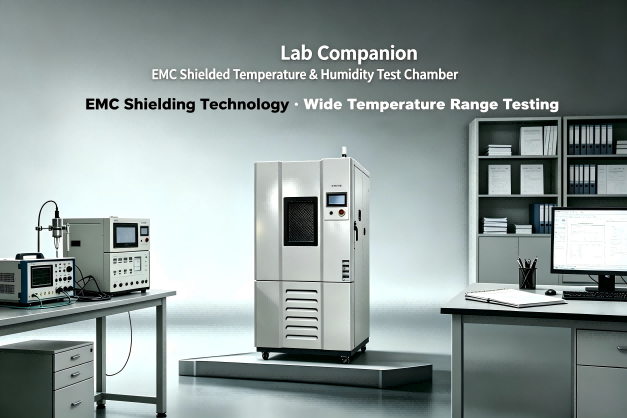
Lab Companion EMC temperature chambers are engineered to eliminate RF leakage and self-noise fundamentally, delivering stable, repeatable thermo-EMC coupled test performance for global R&D and compliance labs.
4.1 Integrated Shielded Inner Chamber with Ultra-Low Leakage Structure
Lab Companion adopts a fully welded container-style shielding inner chamber, structurally isolated from the outer frame to ensure complete shielding integrity.
• Door Shielding: Precision beryllium copper or stainless steel finger stocks ensure uniform contact resistance and long-term shielding stability after repeated cycling.
• Shielded View Window: Multi-layer metal mesh embedded glass provides over 50dB shielding effectiveness from 0.5GHz to 3.0GHz (typical value), balancing visibility and RF isolation.
• Waveguide Cutoff Penetration: All refrigeration pipes and drainage tubes pass through cutoff tubes with a length of at least 3 times the tube diameter, blocking RF wave propagation along metallic pipelines.
4.2 Customizable Filtered Interface Panel System
Lab Companion’s modular interface panel solves the critical pain point of unfiltered cable penetration. Customers can configure dedicated, pre-filtered ports to fix test wiring topology permanently, ensuring excellent test repeatability.
|
Penetration Type |
Lab Companion Standard Solution |
Optional Upgrade |
|
AC Power (220V/380V) |
Two-stage EMI filter, ≥60dB differential & common-mode attenuation @150kHz~30MHz |
High-grade customized filters |
|
DC Power (12V/24V/48V) |
Filtered connectors + feedthrough capacitors for common-mode suppression |
Surge protection module integration |
|
Low-Speed Signals (CAN/LIN/RS485) |
Filtered D-sub connectors with independent π-filter per line |
Fiber optical isolation penetration |
|
RF Signals (Antenna/Probe) |
N/SMA feedthrough connectors with waveguide cutoff structure |
7/16 DIN / BNC customized interfaces |
|
Fiber Optic |
Standard FC/SC/LC non-conductive feedthrough flanges |
Armored fiber protection tube |
4.3 Low-Noise Electrical Design to Eliminate Self-Interference
To avoid chamber self-noise overriding DUT weak signals, Lab Companion optimizes every electrical component:
• Zero-crossing SSR heating control reduces high-speed switching harmonics;
• Compressor VFD equipped with input EMI filters and shielded grounding cables;
• Low-noise brushless DC fans with ferrite core noise suppression;
• Independent shielded housing for control units and separated power/signal wiring layout.
The final empty-chamber noise floor is extremely low across the full temperature range, ensuring only genuine DUT electromagnetic characteristics are measured.
5. Real-World Application Case: Automotive Electronics EMC Problem Solving
A global Tier 1 automotive supplier needed to verify the radiated emission performance of a new domain controller under -40℃~+85℃ temperature cycling.
Initially, the customer used a standard thermal chamber with temporary wiring penetrations. The setup caused 8dB noise elevation at low temperatures and external RF signal coupling at high temperatures, leading to false failure judgments.
After upgrading to a Lab Companion 408L EMC shielded temperature chamber with customized filtered interfaces (4-channel power filtering, 2-channel CAN filtering, 2 SMA RF ports), the test environment was fully optimized:
• Full-temperature-range noise floor fluctuation controlled within 2dB;
• A unique low-temperature 125kHz narrow-band emission spike was accurately captured — a failure completely invisible in room-temperature standalone EMC tests;
• The R&D team optimized DC-DC layout and filtering design, achieving formal vehicle-level EMC certification.
6. Selection Guide & Global Service Support
An EMC thermal chamber is not a cosmetic upgrade — it is a professional test system built to eliminate RF leakage and self-noise. Lab Companion’s systematic shielding, filtered interface customization, and low-noise electrical design fully meet thermo-EMC coupled test requirements for automotive, industrial, renewable energy, and high-precision electronics worldwide.
For accurate solution evaluation before purchasing, please prepare the following key parameters:
• DUT dimension, weight and power consumption
• Required temperature range and ramp rate
• EMC test frequency band and limit standards
• Detailed list of power, signal and RF penetration ports
Global Online Technical Support
Lab Companion provides full-range online technical guidance, remote commissioning, and after-sales technical support for global users. To adapt to overseas deployment scenarios, we do not offer on-site door-to-door service. Professional engineers deliver fast, accurate remote support for equipment setup, parameter configuration, testing debugging, and daily technical consultation, ensuring stable and efficient operation of your test system.


 Получить цену
 Поддерживается сеть IPv6