1. Reliability Testing Requirements for Enterprise-Grade SSDs
1.1 Operating Temperature Range & Thermal Cycling Requirements
Enterprise-grade solid-state drives (SSDs) are widely deployed in data centers and servers under high-load conditions. They must maintain consistent read/write performance across a wide temperature envelope. In accordance with JEDEC standards, industrial storage devices are qualified for an operating temperature range of -40°C to +85°C and a storage temperature range of -55°C to +125°C. Rapid thermal cycling between extreme high and low temperatures verifies the reliability of flash chip packages under abrupt temperature transitions. Visit https://www.lab-companion.com/ for more information.
1.2 Differentiated Requirements Across R&D to Mass Production
SSD reliability validation is not limited to a single test phase.
R&D phase: Wide temperature range and high-precision control to capture performance limits under extreme conditions
Design validation phase: Repeatable and consistent test results for EVT/DVT qualification
Pilot run phase: Scalable capacity for batch parallel testing
Mass production phase: High throughput, automated operation and long-term stable runtime
A unified thermal cycling platform covering the full product lifecycle reduces capital expenditure and significantly improves test efficiency.
2. SSD Failure Mechanisms under Thermal Stress
2.1 Performance Drift Induced by Thermal Cycling
Temperature fluctuations alter the electrical characteristics of flash memory particles and controllers. Repeated cycling between -40°C and +85°C may cause drift in flash read/write performance and timing parameters, alongside shifts in controller power consumption and temperature-sensitive variables. Sustained thermal stress can lead to solder joint fatigue and package interface delamination, manifesting as intermittent read/write errors or inconsistent performance.
2.2 Data Retention and Batch Consistency
Enterprise-grade SSDs have stringent data retention specifications. Thermal cycling accelerates charge leakage and degrades data retention performance. Batch consistency is critical during mass screening: uneven temperature stress across samples leads to ambiguous failure judgment, making chamber temperature uniformity a key performance metric.
3. Applicable Standards
3.1 JESD22-A104 Temperature Cycling
Temperature cycling tests for enterprise-grade SSDs generally follow JEDEC JESD22-A104. Tests are performed between -40°C and +85°C with defined dwell times at temperature plateaus, simulating alternating cold and hot operating conditions. The standard specifies clear requirements for temperature ramp rate and cycle count.
3.2 ESS (Environmental Stress Screening) Methodology
Environmental Stress Screening (ESS) is widely adopted in mass production. High-accelerated thermal cycling applies controlled stress to units under test to precipitate latent defects, exposing early failures before shipment. It balances validation rigor and production throughput.
4. Lab Companion Solution
4.1 Rapid Thermal Cycle Chamber for R&D & Validation
The Lab Companion rapid thermal cycle chamber is designed for temperature cycling reliability testing of enterprise-grade SSDs. Key specifications:
Temperature range: -70°C ~ +150°C, fully covering the -40°C ~ +85°C operating window and -55°C ~ +125°C storage window
Temperature stability: ≤ ±0.5°C; temperature deviation: ≤ ±2°C, ensuring uniform stress across multiple DUTs
Ramp rates: 5°C/min, 10°C/min, 15°C/min, 20°C/min, 25°C/min available; linear and non-linear profiles supported. Rates ≥15°C/min suit high-acceleration qualification
Data logging: Automatic recording of temperature profiles and actual ramp rates for correlation analysis with SSD read/write logs
4.2 ESS Chamber for Mass Production Screening
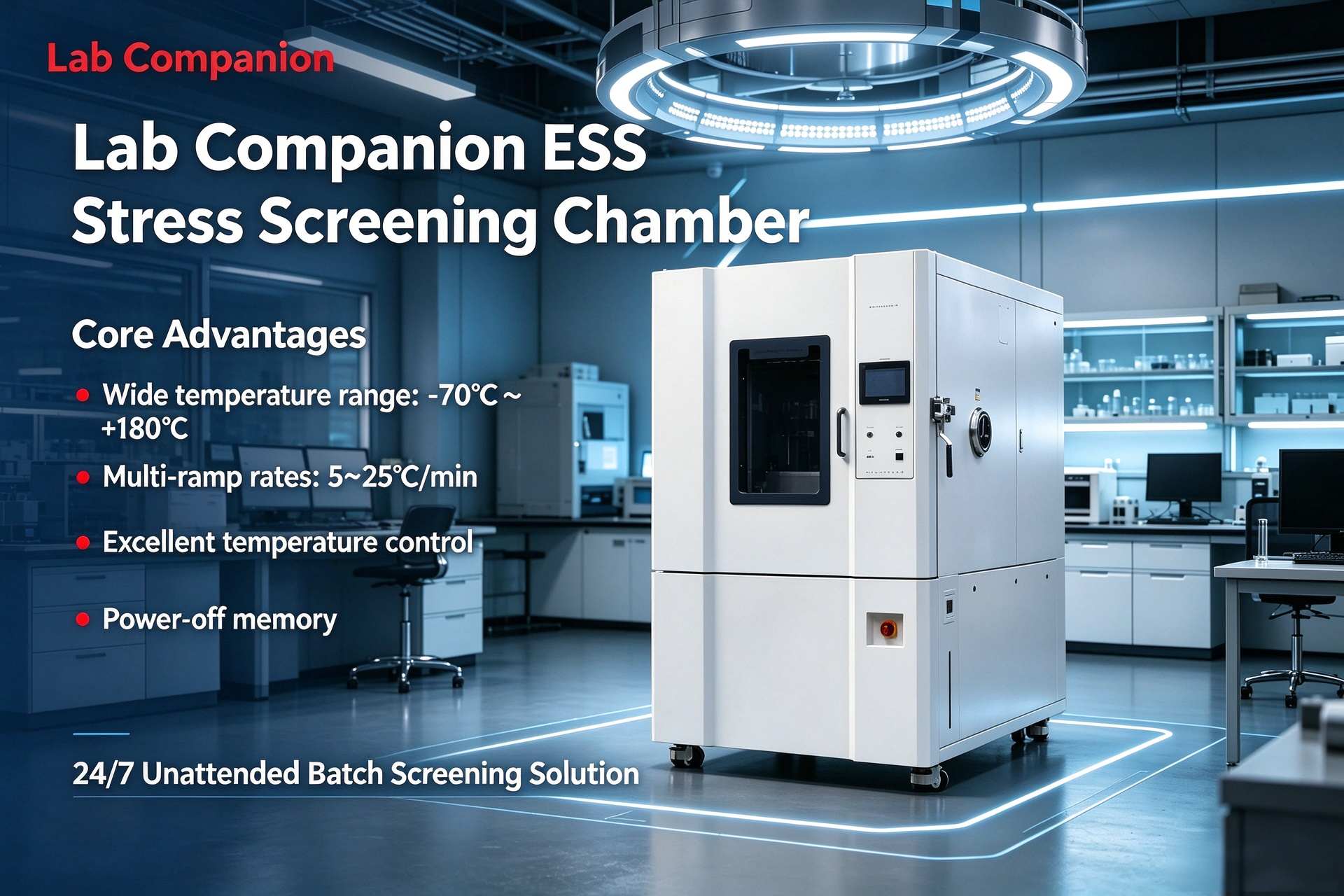
Lab Companion ESS chambers deliver high-throughput, automated stress screening for large-volume production:
Temperature range: -80°C ~ +200°C
Ramp rate: Adjustable from 1°C/min to 30°C/min, linear or non-linear; custom high-acceleration profiles up to 25°C/min available
Temperature stability: ≤ ±0.5°C; empty-chamber uniformity: ≤ ±1.5°C
Batch capability: Compatible with multi-layer fixture racks to screen multiple SSDs simultaneously, effectively eliminating early failures and lowering per-unit test cost
5. Conclusion
The reliability of enterprise-grade SSDs depends not only on flash and controller quality but also on a complete thermal validation workflow spanning R&D, validation, pilot and mass production. Lab Companion rapid thermal cycle chambers and ESS screening systems support JESD22-A104 thermal cycling and production ESS screening. They deliver stable temperature control, traceable data and scalable batch testing for enterprise SSD reliability qualification.
Если вы заинтересованы в нашей продукции и хотите узнать более подробную информацию, пожалуйста, оставьте сообщение здесь, мы ответим вам, как только сможем.






 Получить цену
 Поддерживается сеть IPv6