баннер
Дом

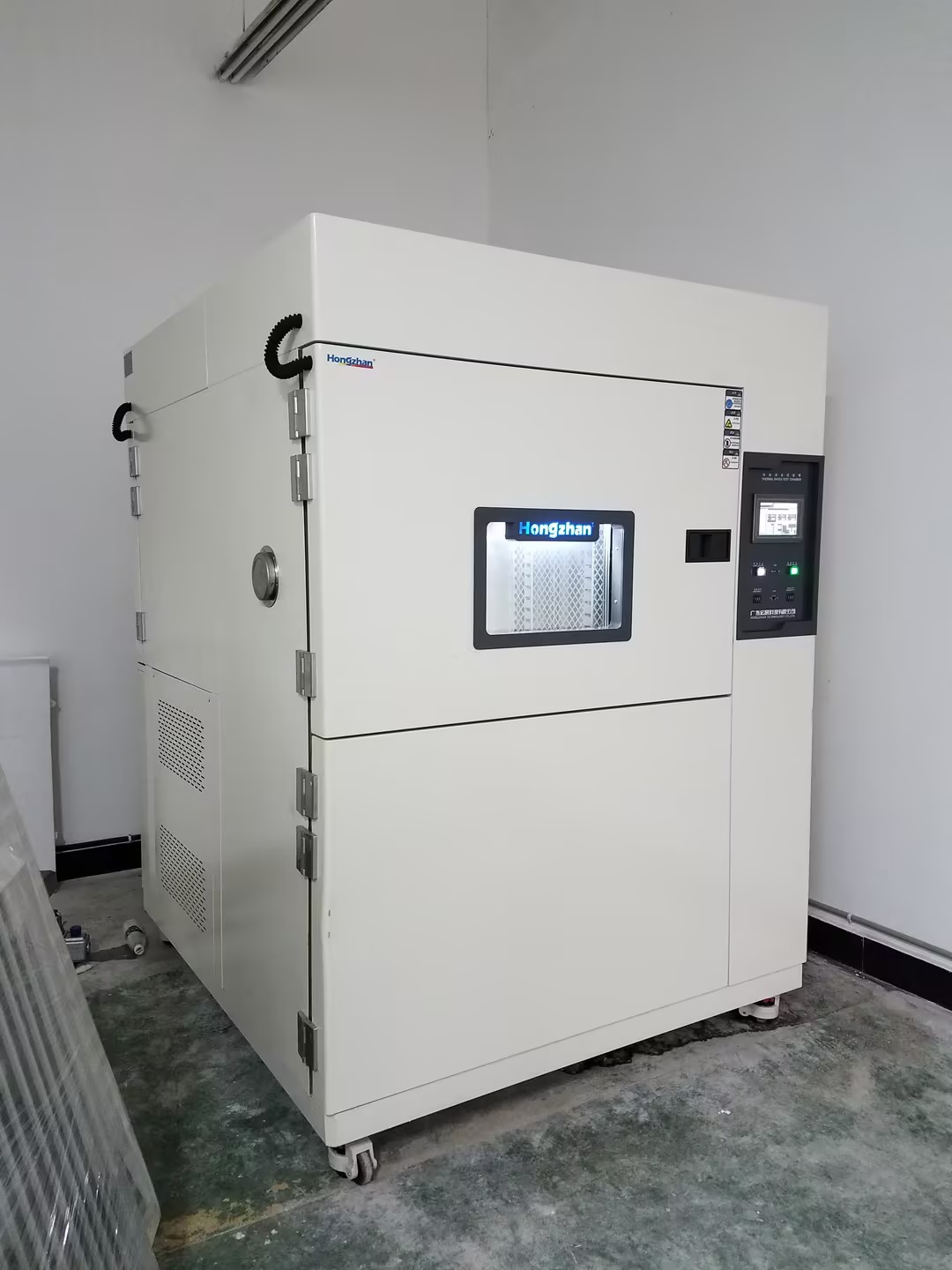
Three-Chamber Thermal Shock Chamber

Three-Chamber Thermal Shock Chamber

  • Three-Chamber Thermal Shock Chamber: A "Touchstone" for Reliability Under Extreme Conditions - In-depth Analysis of Its Working Principle Three-Chamber Thermal Shock Chamber: A "Touchstone" for Reliability Under Extreme Conditions - In-depth Analysis of Its Working Principle
    Dec 18, 2025
        In fields such as electronics and automotive, a product's ability to withstand sudden temperature changes is crucial to its reliability. As a key device for simulating extreme temperature differences, this article will analyze the working principle of the three-chamber thermal shock chamber and reveal the core of its "freezing-heating alternation" technology. I. Core Definition: What is a Three-Chamber Thermal Shock Chamber? The three-chamber thermal shock chamber tests samples by rapidly switching between high and low temperature environments. With an additional independent test chamber, it achieves precise temperature control and fast switching among the three chambers, effectively evaluating the performance stability of products under sudden temperature changes. II. Structural Foundation: Synergy of Three Chambers and Core Systems The operation of the equipment relies on the precise cooperation of "three chambers + four systems". Clarifying the functions of each component is the key to understanding its working logic. 1. Three Chambers: The "Environment Switching Station" for Tests High-temperature Chamber: Provides a high temperature range from room temperature to over 150℃ through heating elements. Fans and air ducts ensure uniform heat distribution, guaranteeing test accuracy. Low-temperature Chamber: Achieves a deep low temperature range of -60℃ to -80℃ using cascade refrigeration technology. Air circulation devices maintain stable low-temperature distribution. Test Chamber: Serves as the core channel connecting the high and low temperature chambers. Its quick-opening/closing door (≤10 seconds) reduces temperature loss and ensures shock effect. 2. Four Systems: The "Power Core" of Equipment Operation Temperature Control System: High-precision sensors work in conjunction with PID controllers to achieve a temperature control accuracy of ±0.5℃. Refrigeration System: Cascade technology combined with refrigerants R404A and R23 rapidly achieves stable deep low temperatures. Mechanical Transmission System: A stepping motor drives the sample rack for fast and accurate transfer between the three chambers, ensuring automatic operation. Air Circulation System: Centrifugal fans and customized air ducts form convection, avoiding temperature deviation in local areas of the sample.   III. Working Process: A Complete Closed Loop from Heating to Shock Taking the "high-temperature → low-temperature" shock as an example, the equipment operates in an automatic closed loop, with the process as follows: Preparation and Preheating: Fix the sample and set parameters (e.g., 120℃/-40℃, 30 minutes of heat preservation, 10 cycles). After startup, the high and low temperature chambers simultaneously reach the target temperatures and maintain them. Rapid Shock: After the high-temperature preservation, the sample is transferred to the low-temperature chamber through the test chamber within ≤10 seconds, completing the first shock. Circulation and Completion: After low-temperature preservation, the sample is transferred back to complete the reverse shock. The circulation continues until the set number of cycles is reached, then the equipment shuts down. The sample is inspected and test data is recorded.   IV. Core Technology Highlights: The Key to Ensuring "Precise Shock" The core competitiveness of the equipment stems from two key technologies: Rapid Temperature Response Technology: The high-temperature chamber adopts efficient heating and flow disturbance design, while the low-temperature chamber uses cascade refrigeration and anti-frost technology, ensuring fast and stable temperature changes. Seamless Switching and Sealing Technology: The test chamber features double sealing and a pneumatic quick-opening door, isolating air flow while balancing efficiency and service life.   V. Application Scenarios: Where is Thermal Shock Testing Needed? Such tests are required for mobile phone chips, automotive sensors, etc. They can expose potential defects in advance, such as material cracking and solder joint detachment, providing data support for product improvement. In summary, the three-chamber thermal shock chamber, with its core of "temperature control of three chambers (high-temperature chamber, test chamber, low-temperature chamber) + synergy of four systems", is a key equipment for ensuring product quality in high-end manufacturing.
    ЧИТАТЬ ДАЛЕЕ
  • How Does a Three-Chamber Thermal Shock Chamber Safeguard Product Reliability in Extreme Environments?
    Dec 17, 2025
        In industrial manufacturing and R&D, "environmental adaptability" is a core product quality indicator. High-precision sectors like electronics, automotive, and aerospace demand exceptional product stability under severe temperature fluctuations. The three-chamber thermal shock chamber, a professional tool for simulating extreme temperature changes, has become essential for enterprises to ensure product reliability. This article analyzes this key testing equipment. I. What is a Three-Chamber Thermal Shock Chamber? A three-chamber thermal shock chamber conducts thermal shock tests by rapidly switching between high and low temperature environments. Its core is the independent "high-temperature + low-temperature + test chamber" structure, which enables faster temperature changes and precise control compared to two-chamber designs (shared high-low temperature chamber), avoiding transitional temperature interference and replicating real extreme conditions. Key parameters: temperature range (-40℃~150℃ for high-temp chamber, -60℃~ambient for low-temp), shock rate (>10℃/s max), test chamber volume, and temperature uniformity (≤±2℃). These are customizable per industry standards. II. Core Working Principle: Rapid Temperature "Energy Switching" Its operation relies on "independent temperature control + rapid switching", with four key steps: 1. Zoned Control: High-temp chamber uses electric heating/hot air; low-temp chamber uses liquid nitrogen/cascade refrigeration. Both employ independent closed-loop control for stability. 2. Sample Placement: Sample is placed on a movable rack in the ambient-temperature test chamber initially. 3. Shock Cycle: Rack moves sample between high/low-temp chambers per program, simulating "high-low-high" cycles. 4. Data Monitoring: Built-in sensors record real-time temperature and sample performance for analysis. Compared to two-chamber models, it eliminates temperature balance time (boosting efficiency by 30%+), avoids cross-contamination, and ensures more reliable results. III. Core Advantages: Precision, Efficiency, and Stability - Extreme Temp Range: -60℃~180℃, 15℃/s max rate, simulating plateaus/polar/aviation conditions. - Precise Control: No temperature gradient; uniform heating/cooling, repeatability error ≤±1℃. - High Efficiency: No chamber transition waits, ideal for batch sample screening. - Wide Applicability: Suitable for electronics, automotive parts, aerospace components. IV. Typical Application Scenarios: Full-Link Coverage from Laboratory to Production Line Its core role is early defect detection, covering R&D, sampling, and quality tracing. Key applications focus on high-reliability industries: 1. Electronics and Electrical Industry: "Extreme Test" for Components Electronic components (chips, capacitors, PCBs) face frequent temperature changes. This test reveals thermal expansion/contraction defects (solder cracks, package aging). For example, 5G base station chips undergo 1,000 cycles at -40℃~85℃ for climatic adaptability. 2. Automotive Industry: "Environmental Adaptability Verification" for Vehicles and Parts Automobiles endure -30℃~40℃ cross-regional temp swings, demanding durable components. The chamber tests headlights, battery packs, displays, and seals. New energy vehicle battery packs undergo -20℃~60℃ shocks to verify charging safety; seals are tested for deformation/leakage resistance. 3. Aerospace and Military Industry: "Reliability Guarantee" in Extreme Environments Aerospace equipment (-50℃~100℃ liftoff temp changes) requires rigorous testing. Satellite solar panels undergo 2,000 cycles at -60℃~150℃ for space stability; aircraft black boxes are tested to ensure crash data preservation. 4. New Materials and Packaging Industry: "Pre-Screening" for Performance and Safety New materials (aerospace titanium alloys) use the test to verify mechanical stability. Food/pharmaceutical packaging (aluminum foil, glass) is tested to prevent damage/leakage during refrigeration/transport. V. Conclusion: The "Invisible Guardian" of Reliability Testing      The chamber’s value lies in simulating extreme environments to pre-test products, reducing after-sales risks and boosting competitiveness. As manufacturing advances, it has evolved from a niche tool to a standard asset for R&D and quality control. For temperature reliability testing, select a chamber with parameters matching your products—pre-emptive defect detection is far more effective than post-failure fixes.
    ЧИТАТЬ ДАЛЕЕ

оставить сообщение

оставить сообщение
Если вы заинтересованы в нашей продукции и хотите узнать более подробную информацию, пожалуйста, оставьте сообщение здесь, мы ответим вам, как только сможем.
представлять на рассмотрение

Дом

Продукты

WhatsApp

связаться с нами