Свяжитесь с нами по электронной почте :
info@labcompanion.cn
-

-

Запрос звонка :
+86 18688888286

1. Real-World Thermal Challenges for New Energy Electronic Components
1.1 Extreme Temperature Cycling in Field Operation
New energy vehicles, photovoltaic power generation, and energy storage systems operate in fully exposed outdoor environments, where core electronic units endure drastic temperature swings from extreme cold to extreme heat. Reliability under wide temperature ranges is critical for system safety, efficiency, and service life.
A Battery Management System (BMS) is installed inside vehicle battery packs. In cold regions, internal pack temperatures can drop below -20 °C or even -30 °C during winter parking. In summer, solar radiation plus fast-charging heat can raise internal temperatures above 50 °C. The BMS must maintain accurate temperature sampling, cell voltage monitoring, passive/active balancing, and stable communication across the entire operating temperature spectrum.
PV inverters and Power Conversion Systems (PCS) face harsher ambient conditions. Desert summer cabinet temperatures can exceed 60 °C, while winter nights drop below -20 °C. Coastal regions combine high temperature with high humidity. Key components including IGBT modules, electrolytic capacitors, magnetic devices, and main control boards are highly temperature-sensitive. Excessive temperature deviation causes derating, over-temperature protection, reduced power generation efficiency, and unexpected system downtime.
1.2 Superimposed Heat Load from High-Power Operation
Unlike conventional consumer electronics, new energy power devices generate significant internal heat during high-rate charging, discharging, and full-load operation. Inverters produce continuous high power loss through IGBT switching and conduction, creating steep thermal gradients inside enclosures. When internal heat buildup overlaps with high ambient temperature, component temperatures approach or exceed maximum ratings.
For this reason, static temperature storage testing is insufficient. Real-world reliability verification requires dynamic, powered testing under temperature cycling. Chambers must support full-load operation, long-duration thermal stability, and real-time data monitoring to validate thermal derating, protection logic, and operational stability.
2. Standardized High/Low Temperature Test Items for BMS and Inverters
2.1 BMS Testing: Full-Range Temperature Accuracy & Control Stability
BMS temperature testing focuses on data accuracy, cold-start reliability, and thermal balancing performance across extreme conditions.
Low-temperature startup test: Soak at -20 °C to -40 °C before power-on to verify initialization, cell voltage and temperature sampling accuracy, and CAN communication stability under freezing conditions.
High-temperature operational test: Continuous running at +60 °C to +85 °C under fast-charging and high-discharge load conditions. Engineers monitor temperature sampling error, over-temperature protection thresholds, and balancing current stability.
Temperature accuracy is fundamental for SOC estimation, charge/discharge cutoff control, and fault protection. Minor sampling deviations may lead to incorrect battery strategy and potential safety risks. Lab Companion chambers support precise point-to-point calibration across -40 °C to +85 °C to validate BMS algorithm robustness.
2.2 PV Inverter & PCS Testing: Full-Load Stability & Thermal Derating Verification
Inverter testing emphasizes full-load operational reliability and temperature-based derating characteristics under extreme ambient conditions.
High-temperature full-load test: Operate at rated DC input and full AC output for minimum 4 hours at +40 °C to +60 °C. Monitor IGBT junction temperature, capacitor temperature, control board temperature, system efficiency, THD, voltage/frequency stability, and over-temperature protection behavior. Validated results ensure no unexpected derating or shutdown within specified temperature limits.
Low-temperature performance test: Verify cold-start capability and low-load stability at -20 °C to -40 °C. Low temperatures cause capacitance drop and ESR increase in electrolytic capacitors, which may induce bus voltage fluctuation. Tests confirm reliable startup, normal grid-tie/off-grid switching, and no false alarms in cold environments.
2.3 Global Compliance Standards
All test procedures comply with internationally recognized standards, including IEC 60068-2-1 / IEC 60068-2-2, GB/T 2423, as well as industry-specific specifications for BMS (QC/T 897, GB/T 31467) and inverters (NB/T 32004, GB/T 37408, GB/T 34120).
3. Lab Companion Chamber Technical Advantages for New Energy Testing
3.1 Full Volume Range for High-Power Device Testing
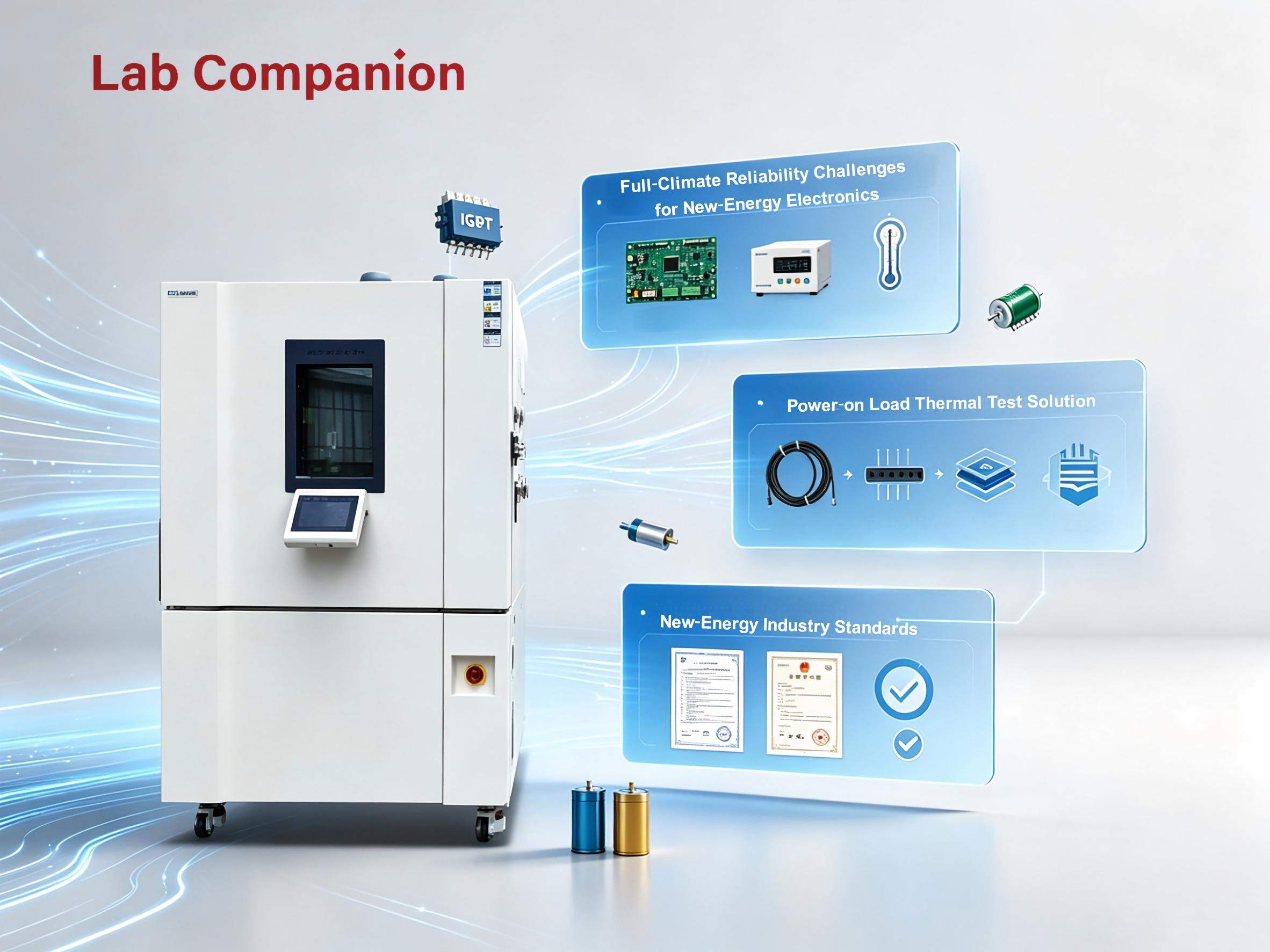
Lab Companion thermal chambers cover a full volume range from 34 L to 1500 L, fully matching new energy testing requirements. Medium and large chambers (340 L–1500 L) are specially optimized for high-calorific and heavy-load samples such as BMS units, onboard controllers, PV inverters, and energy storage PCS systems.
Enhanced heating and cooling systems guarantee rapid temperature recovery and uniform thermal field even with high-power heat-generating DUTs. SUS304 stainless steel interior provides corrosion resistance against electrolyte vapor and industrial dust. Customizable shelf spacing and load-bearing structures ensure stable sample placement and unobstructed internal airflow.
3.2 Ultra-Wide Temperature Range & High Precision Stability
Lab Companion chambers feature a wide temperature range of -70 °C to +150 °C, with customizable low-temperature thresholds to match different project specifications. The operational range fully covers standard BMS and inverter test boundaries with sufficient safety margin for long-term stable operation.
Precision performance meets strict industrial testing requirements: Temperature fluctuation ≤ ±0.5 °C, temperature uniformity ≤ ±2.0 °C (high-precision version ≤ ±0.3 °C). Equipped with proprietary Q8 intelligent control system and balanced temperature & humidity control (BTHC) technology, the chamber avoids temperature overshoot and oscillation, delivering consistent, repeatable thermal conditions for accurate algorithm calibration and reliability validation.
3.3 Customized Cable Ports for Powered & Live Testing
All Lab Companion environmental chambers support customized insulated cable ports for power cables, CAN/RS485 communication lines, and sensor wiring. The sealed and insulated port design prevents cold leakage and thermal field disturbance during long-duration powered tests.
Customers can perform real-time data acquisition including BMS cell voltage, temperature sampling error, SOC balance status, and fault logs. For inverters, users can connect external DC power sources and AC load banks to conduct full-load continuous aging and thermal derating testing, with complete data logging and export functions for technical reports and certification documents.
4. Global Service & Technical Support Model
4.1 Factory Direct Customization & Global Delivery
Lab Companion is a national high-tech enterprise and specialized & sophisticated manufacturer based in Dongguan, China. With 21 years of experience in environmental test equipment R&D and manufacturing, the brand holds Madrid International Trademark registration, as well as EU, UK, and Germany trademark certifications, supporting global project qualification and customer recognition.
We provide worldwide direct shipping and factory customization services, including customized internal dimensions, high-power port configurations, special load-bearing shelves, and tailored thermal solutions for customer-specific inverter and BMS test standards.
4.2 Global Online Remote Technical Support
To serve global customers efficiently, Lab Companion adopts an overseas online support system. We do not provide local after-sales service teams in foreign countries, but deliver full-life-cycle remote technical support.
Our professional international support team providesonline installation guidance, operation training, parameter calibration, program debugging, and remote fault diagnosis. Most technical issues can be resolved efficiently via online guidance, eliminating regional service barriers and ensuring stable and continuous equipment operation for global laboratories and factories.
4.4 Global Industry Application Cases
Lab Companion thermal test chambers are widely used in global new energy vehicle, photovoltaic, and energy storage industries. Our equipment has been adopted by automotive electronics suppliers, renewable energy manufacturers, and university research institutions for BMS temperature calibration, inverter high-low temperature cycling, full-load aging, and thermal derating validation. Stable temperature accuracy and reliable long-duration operation help customers optimize product algorithms, improve extreme environmental adaptability, and accelerate product certification and mass production.
5. Conclusion
Extreme temperature adaptability is a core indicator of reliability for EV BMS, PV inverters, and energy storage converters. Professional high-low temperature testing is essential for product R&D, performance optimization, and global market certification.
Lab Companion environmental test chambers provide ultra-wide temperature range, high-precision thermal stability, high-load compatibility, and customizable powered test interfaces, perfectly matching the full-cycle reliability testing needs of new energy power electronic products. Supported by factory direct customization and professional global remote technical support, we deliver stable, cost-effective, and standardized thermal testing solutions for global new energy enterprises, helping customers enhance product durability and market competitiveness in all-climate operating scenarios.


 Получить цену
 Поддерживается сеть IPv6