Свяжитесь с нами по электронной почте :
info@labcompanion.cn
-

-

Запрос звонка :
+86 18688888286

Introduction: New Reliability Challenges for MEMS Sensors
As a core cluster of the domestic MEMS sensor industry, Suzhou Nano City hosts more than 550 upstream and downstream enterprises and operates China’s first commercial 6-inch MEMS pilot platform. It has formed a complete industrial chain covering chip design, wafer manufacturing, packaging and testing. Driven by the rapid development of IoT, smart vehicles, aerospace and advanced industrial manufacturing, MEMS sensors are evolving toward higher integration, miniaturization and stricter operating conditions.
Against this backdrop, how to quickly and accurately identify latent defects in MEMS sensor design, material selection and production processes has become a universal industry challenge. To address this demand, Lab Companion has launched the HALT-type high-accelerated thermal cycling chamber. Featuring an ultra-high non-linear temperature change rate of up to 20℃/min, the equipment drastically shortens reliability testing cycles and exposes hidden early failures at the R&D stage, helping global MEMS manufacturers consolidate product quality.
1. High-Accelerated Thermal Cycling Testing: Break Traditional Limits for Extreme Reliability Verification
1.1 What is HALT Testing
HALT (Highly Accelerated Life Test) is an advanced reliability verification method applied in the electronic product R&D phase. Its core principle is maintaining consistent failure mechanisms, intensifying environmental stress, and compressing test duration. By applying extreme thermal cycling and temperature shock stress, HALT rapidly excites potential product weaknesses. Short-term accelerated test data can accurately predict product long-term reliability under standard operating conditions, serving as a critical validation solution before formal product finalization.
1.2 Why MEMS Sensors Require HALT Ultra-Fast Thermal Cycling
Integrated with micro-mechanical structures (cantilevers, thin films, resonant cavities) and precision signal processing circuits, MEMS sensors are far more sensitive to thermal stress and thermal expansion/contraction than conventional electronic components. Standard thermal cycling tests fail to effectively trigger latent failures. The main failure modes of MEMS sensors are summarized as follows:
• Microstructure Fatigue & Fracture: Repeated temperature fluctuations induce fatigue cracks on micro-cantilevers and resonant structures, leading to functional degradation over service time.
• Microstructure Adhesion & Friction Failure: Rapid thermal stress causes irreversible adhesion and stalling of micro-scale structures, undermining sensing accuracy.
• Packaging Thermal Stress Mismatch: Differential thermal expansion coefficients among chips, encapsulation materials and substrates cause stress concentration, resulting in packaging delamination and cracking.
• Interconnection & Solder Joint Failure: Extreme temperature shocks generate microcracks in internal solder joints and circuit interconnections, eventually causing poor contact or open circuits.
Conventional thermal cycling chambers only provide a temperature change rate of 1~3℃/min, requiring several hours for a single complete cycle. Such low stress intensity cannot efficiently expose micro latent defects. In contrast, Lab Companion high-accelerated thermal cycling chambers deliver a temperature change rate of over 10℃/min, enabling extreme high-low temperature switching in a short time. The intensified thermal stress effectively exposes design, material and process flaws, supporting iterative optimization before mass production and eliminating batch failure risks.
2. Core Technical Advantages of Lab Companion High-Accelerated Thermal Cycling Chambers
With years of expertise in environmental reliability testing equipment, Lab Companion independently developed the high-accelerated thermal cycling chamber series. It fully adapts to the full-cycle testing requirements of MEMS sensors from R&D verification to mass screening, solving traditional industry pain points including low efficiency, insufficient precision, contamination risks and incomplete data traceability.
2.1 Customizable Ultra-High Temperature Change Rate, 4X Higher Testing Efficiency
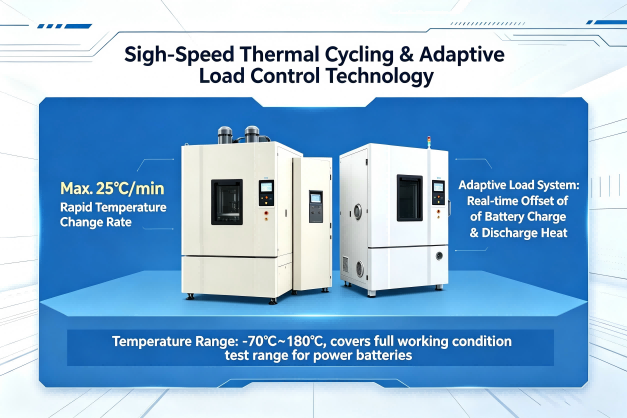
The equipment supports customizable linear and non-linear temperature change rates ranging from 5℃/min to 25℃/min, with top-tier models reaching 25℃/min — far exceeding conventional industry equipment. Taking the mainstream -40℃~125℃ thermal cycle test as an example, traditional devices take 2 hours per cycle, while Lab Companion chambers complete one cycle within 30 minutes. The solution achieves 4 to 5 times more cycles in the same testing period, efficiently stimulating latent failures such as microstructure fatigue and packaging stress defects. Users can freely switch between constant linear temperature change and segmented controllable non-linear acceleration modes according to diverse test standards.
2.2 Wide Temperature Range & High-Precision Control for Batch Test Consistency
Covering a full temperature range of -70℃ to +180℃, the chamber meets all-scenario MEMS testing demands including low-temperature cold start, normal operation, high-temperature storage and extreme temperature resistance. Equipped with a dual-air duct circulation system and distributed multi-point temperature sensors, it achieves a steady-state temperature uniformity of ≤±0.5℃ and dynamic uniformity better than ≤2.0℃ during rapid temperature changes. The balanced and precise thermal field supports synchronous batch testing of multiple MEMS sensors, eliminating data deviation caused by local temperature differences and ensuring highly reliable and consistent test results.
2.3 High-Cleanliness Chamber Design for Precision Chip Testing
MEMS bare dies and micro sensors are extremely sensitive to test environment cleanliness. Tiny dust and particle adhesion may cause test misjudgment or irreversible component damage. Lab Companion optimizes the chamber structure specifically for precision semiconductor testing scenarios. Adopting SUS304 mirror stainless steel inner tank and dead-angle-free arc welding technology, the inner wall minimizes particle adhesion and shedding risks. It perfectly adapts to high-precision scenarios such as wafer-level packaging and bare die testing, ensuring authentic test data and stable product yield.
2.4 Intelligent Programmable Control & Full-Cycle Data Traceability
Equipped with a self-developed high-definition programmable controller with bilingual (Chinese/English) interface, the device stores 100 groups of programs with 100 segments per group. It supports one-click calling of mainstream industry standards including JEDEC, MIL-STD and AEC-Q100, realizing unattended automatic testing. Integrated with Ethernet remote monitoring and USB data export functions, the chamber synchronizes real-time temperature curves, operating status and alarm information. All test data is automatically recorded, fully complying with data traceability requirements of IATF 16949 and ISO 17025 quality systems.
3. Typical Application Cases
Case 1: Extreme Thermal Stress Verification for MEMS Inertial Accelerometers
A professional IMU inertial sensor enterprise requires its vehicle-grade MEMS accelerometers to withstand harsh automotive operating conditions. At the product finalization stage, the enterprise adopted Lab Companion high-accelerated thermal cycling chamber with the test scheme: -55℃~+125℃ temperature range, 20℃/min non-linear temperature change rate, 10-minute dwell time per segment, 200 consecutive cycles.
The intensive alternating thermal stress quickly activated latent defects and exposed fatigue cracks on microstructure fixing anchors within 100 cycles. Based on failure analysis, the enterprise optimized the stress relief groove design of microstructures. Re-testing verified the complete elimination of similar failures, greatly improving the product’s thermal shock resistance and operational stability under extreme vehicle conditions.
Case 2: Temperature-Humidity Combined Accelerated Test for Smartphone MEMS Microphones
A professional acoustic module manufacturer encountered abnormal acoustic sensitivity attenuation of new-generation smartphone MEMS microphones under high-temperature and high-humidity environments. Traditional long-period humidity and temperature tests failed to quickly locate the root cause.
The enterprise adopted Lab Companion temperature-humidity composite high-accelerated thermal cycling chamber with combined thermal and humidity stress. The test parameters were set as15℃/min temperature change rate, 10%~95% RH humidity range and 50 test cycles. The accelerated test quickly confirmed that alternating rapid temperature and humidity fluctuations caused expansion and deformation of the waterproof and breathable membrane, resulting in sealing performance degradation. The manufacturer replaced the membrane with high humidity-resistant material, thoroughly solving the acoustic sensitivity failure and achieving rapid product iteration.
Case 3: Mass Stress Screening for Automotive-Grade MEMS Pressure Sensors
A leading automotive sensor supplier produces tire pressure monitoring MEMS pressure sensors that comply with strict AEC-Q100 automotive standards, requiring efficient batch defect screening during mass production.
The enterprise introduced Lab Companion high-accelerated thermal cycling chambers for mass production screening. The equipment supports simultaneous testing of 500 sensors per batch. With the test condition of -40℃~125℃ and 20℃/min ultra-fast temperature change, the original 24-hour screening cycle is shortened to 4 hours. The internal temperature uniformity is stably controlled within ±1.5℃, ensuring consistent thermal stress for all samples. This solution increases the defective product detection rate by 30% and reduces comprehensive screening costs by nearly 50%, balancing high screening accuracy and mass production efficiency.
4. Global Professional After-Sales & Technical Support
Lab Companion provides standardized global after-sales service and full-lifecycle technical support for overseas customers, ensuring stable and efficient equipment operation worldwide:
• Global Online Technical Support: Professional engineering teams provide 7×24-hour remote guidance, including equipment debugging, operation training, fault diagnosis and solution delivery.
• Standard Spare Parts Supply: Standardized spare parts and consumables are available globally to shorten equipment downtime and ensure continuous operation.
• Regular Calibration & Maintenance Guidance: Provide free annual remote equipment calibration, system inspection and maintenance guidance services.
• Customized Process Technical Training: Offer standardized operation documents and professional technical training, assisting customers in formulating test procedures compliant with JEDEC, MIL-STD, AEC-Q100 and other international standards.
• Extended Warranty Service: Optional extended warranty covers vacuum system maintenance, temperature sensor calibration and temperature control system inspection, guaranteeing long-term stable equipment performance.
5. Core Product Advantages Summary
• Industry-Leading Ultra-Fast Thermal Cycling: Customizable 5~25℃min temperature change rate, 4 times higher efficiency than traditional equipment, supporting high-frequency accelerated thermal cycle testing.
• High-Precision Full-Range Temperature Control: -70℃~180℃ ultra-wide temperature range, stable dynamic and static temperature uniformity, ensuring consistent batch test data.
• High-Cleanliness Precision Test Environment: Mirror stainless steel anti-pollution structure, suitable for high-standard testing of MEMS bare dies and packaged precision components.
• Standardized Global Data Traceability: Intelligent programmable control and remote monitoring system, fully compliant with international quality system certification requirements.
• Professional Global Technical Service: 24/7 online remote support and standardized after-sales system to minimize equipment operating risks and losses.
Conclusion
As foundational core components of intelligent terminals, smart vehicles, aerospace and industrial manufacturing, MEMS sensors determine the quality and stability of terminal products. High-accelerated thermal cycling testing is an essential method to excavate latent defects and improve the inherent reliability of MEMS devices from the source.
With advanced ultra-fast thermal cycling technology, high-precision temperature control, exclusive high-cleanliness design and standardized global service system, Lab Companion provides efficient, professional and compliant reliability testing solutions for global MEMS manufacturers. We help MEMS products improve extreme condition adaptability and overall reliability, empowering the high-quality development of global precision electronic component industries.


 Получить цену
 Поддерживается сеть IPv6